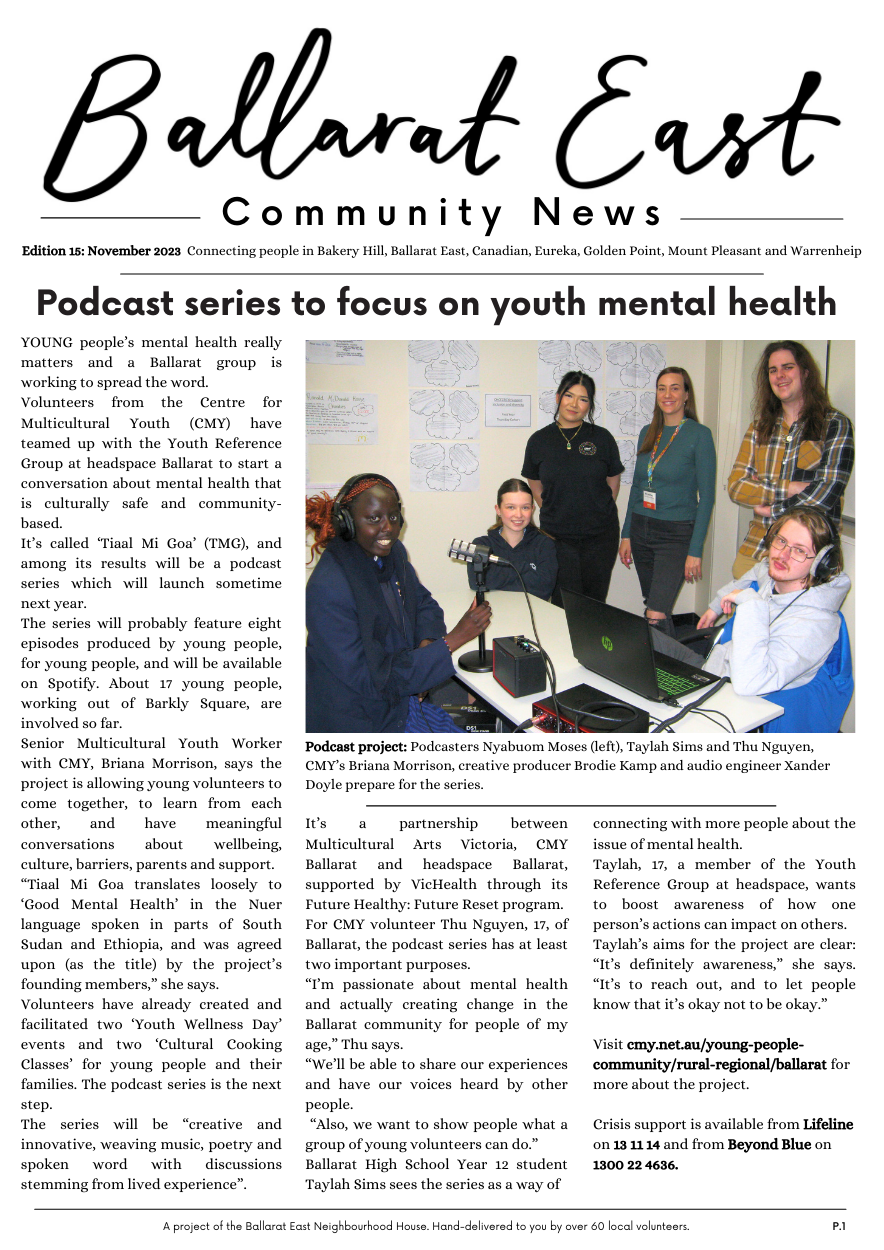
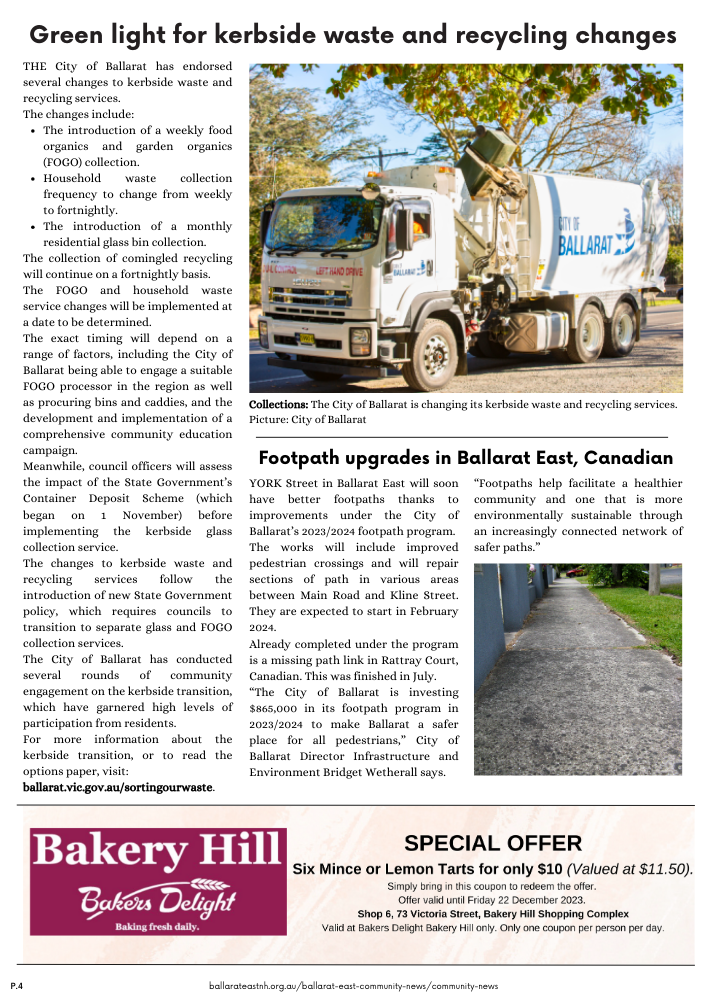
Edition 15 - November 2023
Edition 15




Governance for Community Groups
New reporting requirements from ATO for not-for-profit groups
Does your group have an active ABN?
If your community group is not registered as a charity with the ACNC and you have an active ABN then you will be required to lodge an annual self-review return with the Australian Tax Office (ATO) from the end of the financial year ending 30 June 2024 onwards. For the financial year ending 30 June 2024 the new form is available online and needs to be completed by 31 March 2025.
From 1 July 2025 onwards, the expectation is that the return needs to be lodged by 31 October each year.
The law relating to tax has not changed but the reporting requirements for not-for-profit groups have.
To help you work out what you need to do to complete the NFP Self Review Return
- Watch 45 minute webinar from ATO New reporting requirements for not-for-profits (viostream.com)
- Work through ATO not-for-profit self-review guide How to prepare a NFP self-review return | Australian Taxation Office (ato.gov.au)
- Contact ATO not-for-profit advice service - 1300 130 248 Monday – Friday 8.00am -6.00pm
- Sign up for ATO not-for-profit news. ATO - Subscribe - Subscribe
Download the ATO NFP Self-Review Return Flowchart below as a PDF with active links to the relevant websites.

Registering as a charity with Australian Charities and Not-for-profit Commission
Is your community group registered as a charity with the Australian Charities and Not-for-profit Commission (ACNC)? If not, are you eligible to be registered as a charity and do you know how to do it?
To find out more about seeking registration as a charity please see the information on the Justice Connect website Top tips for applying for charity registration with the ACNC | Not-for-profit Law (nfplaw.org.au) These are slides from a recent webinar that provide some valuable information for you. To get access to the slides and the recording you may need to register with Justice Connect – follow the links.
Additional information about applying for charity status can be found on the ACNC website https://www.acnc.gov.au/for-charities
In the meantime, if you have any questions relating to your group please contact Kay Miller, Community Governance Officer email This email address is being protected from spambots. You need JavaScript enabled to view it. or on mobile 0460 699 669.
National Police Checks

Volunteers and students on placements can apply for a national police check at a reduced fee of $29.40 (instead of the full $86.50).
Learn more about applying for volunteer checks
Volunteers and students on placements can apply for Working With Children Checks for free (instead of the employee rate of $131.60).
Learn more about applying for a Working With Children Check.
If you need help applying, please contact us at the Ballarat East Neighbourhood House.
Participant Payment Plan
Ballarat East Neighbourhood House – Participant Payment Plan
Last updated 11 April 2023
Welcome to the Ballarat Neighbourhood House Payment Plan. We are pleased to offer this payment option to our participants on a case-by-case basis in order to make our activities accessible to everyone.
The Ballarat East Neighbourhood House is a small non-profit charity and we work with the community to enrich the social connection of communities in Ballarat East and surrounds.
Need for a Participant Payment Plan
Before we confirm our activities at the start of each term, we need to ensure that costs (room hire, teacher costs, equipment and supplies) will be covered by having a minimum number of participants registered. Also, many of our activities have limited numbers due to the room size. To secure a place in these activities, participants need to register and pay in full for the term.
The Payment Plan allows participants the flexibility to register for an activity and set up a payment agreement for the full-term cost.
How the Participant Payment Plan works
Generally, our activities are free or cost between $10 and $20 per session (1 to 3 hours). When a participant pays upfront for a term (usually between 8 and 10 weeks), they receive a discount to the value of one session.
The Participant Payment Plan includes but is not limited to:
- An opportunity to negotiate payment for the full term’s pricing of an individual activity.
Example: 7-week activity valued at $10/week = $70 value
Total cost of activity if paying for the full term = $60 (saving cost of one session)
Payment Plan in ¼ payments: $15 x 4 instalments OR
Payment plan in ½ payments: $30 x 2 instalments
- Payment of the full term pricing must be paid out before the end of the term.
Example: Activity dates: 5 May - 19 June (7 Weeks)
Payments scheduled: 5 May/12 May/19 May/ 26 May.
- Signing up to a Participant Payment Plan is a binding legal document with the Ballarat East Neighbourhood House. Signing this form is your agreement to pay the full amount and secure a spot within an activity.
- Failure to fulfill payment negotiated terms will result in a loss of registration in the activity and a forfeit of payments already received.
- Unforeseen individual circumstances will be taken into consideration. Please refer to Ballarat East Neighbourhood House Refund Policy (available: https://www.ballarateastnh.org.au/about-us/policies-procedures). All refund requests must be in writing to the Manager of the Ballarat East Neighbourhood House, Barkly Square, 25-39 Barkly Street, Ballarat East, Victoria 3350.
- Ballarat East Neighbourhood House reserves the right to refuse or retract Participant Payment Plan offerings.
Child Safe Standards
The Community Governance Project funded by City of Ballarat is working to provide support to community groups in the City of Ballarat, delivered by the four Neighbourhood Houses in Ballarat through a Strategic Partnership.
Victoria's Child Safe Standards
Victoria’s Child Safe Standards are a set of mandatory requirements to protect children and young people from harm and abuse.
Operational from 1 July 2022
Do the Child Safe Standards apply to your community group or organisation?
To answer this question please go to the web site of Commission for Children and Young People
CCYP | Who do the Standards apply to?
If you are still unsure, please contact the Commission for their guidance
This email address is being protected from spambots. You need JavaScript enabled to view it. or phone 1300 78 29 78.
If they do apply to your group or organisation, then you will need to take steps to comply with the standards. The CCYP website has a lot of resources and support to assist you with your compliance.
CCYP | Resources and support for the Child Safe Standards
If you are a sporting organisation then you can find information and resources here
Child Safe Sport — Vicsport
If you want to discuss any issues raised in complying with these standards, please contact us.

We all want to protect children when they engage with our community organisation or group.
Children have the right to feel safe and to be safe all the time but this requires commitment from everyone in the community.
The updated Child Safe Standards introduced into Victoria have been applicable from 1 July 2022. The standards support community organisations and groups to become child safe organisations.
The Neighbourhood Houses in Ballarat have been working through the standards, making some improvements to the way we operate to ensure children are, and feel, safe at all times when interacting with us. There are many of different ways in which community organisations already have a child safe culture – but there is always room for improvement. We are happy to talk through the steps we have taken and share ideas and resources to help your community organisation become even safer for children.
For those organisations which are required to comply, the standards are mandatory. Even if your organisation is not required to comply, we strongly suggest that you consider reviewing your policies and procedures to ensure that they put child safety and well-being first and that child safety is in every part of your operations.
Image by Artem Podrez from Pexels.