Child Safe
Children and the Ballarat East Neighbourhood House
The Ballarat East Neighbourhood House is committed to empowering children as vital and active members of our community and our organisation.
We involve them when making decisions about matters which affect them.
We are committed to children’s safety and our legal and moral obligations to act in their best interest.
Child Safe Policies
Child Safe Code of Conduct Policy
Ratified by the Ballarat East Neighbourhood House Committee of Management on 20 July 2022
Child Safe Code of Conduct Policy (PDF)
Policy Declaration
Embedding a culture of empowering children and upholding child safety within the Ballarat East Neighbourhood House (BENH) is integral to our ability to meet the needs of and serve our community. Our Child Safe Code of Conduct outlines the child safe principles and minimum expectations for appropriate behaviour when in the company of children, including young people, at BENH.
Policy Description
Application:
This policy applies to all people who conduct work for, or are connected to, BENH in a paid or unpaid capacity, including staff, CoM Members, volunteers and BENH participants/users. It applies to a broad range of situations where interaction with a person under the age of 18 years (children) may occur including all activities in and organised by BENH which involve, result in or relate to contact with children.
It is important that everyone is aware of BENH’s child safety obligations. Allegations of misconduct involving children can be made against a person even if the conduct occurred outside of their work.
Background:
The Victorian Government Child Safe Standards (The Standards) are compulsory minimum standards for organisations that provide services for children (or are used by children) to help protect them from harm.
Objectives:
The Standards require organisations who provide services for children to have a Child Safe Code of Conduct which establishes clear expectations for appropriate behaviour with children.
Statement of Commitment
Ballarat East Neighbourhood House is committed to the safety, wellbeing and best interests of children. BENH requires all staff to uphold the following commitments. BENH has specific policies, procedures and training in place to achieve these commitments. BENH
- Will uphold the rights of children who come into contact with BENH so that they feel heard on matters relevant to their safety and so that they feel safe and protected.
- Has zero tolerance for child abuse and will take all allegations of reportable conduct and safety concerns very seriously, ensuring such conduct is dealt with in accordance with BENH policies, procedures and the law.
- Is committed to preventing child abuse and identifying risk early, and removing and reducing these risks in both physical and online environments.
- Will actively work to listen to and empower children who come into contact with BENH.
- Has legal and moral obligations to contact authorities when there are concerns about a child, which will be followed rigorously.
- Has robust human resources and recruitment practices for all staff and volunteers.
- Will provide a culturally safe environment for Aboriginal and Torres Strait Islander children and those from culturally and/or linguistically diverse backgrounds and consider their needs in providing that environment.
- Will provide a safe environment for, and consider the needs of, children, and consider their needs in providing that environment recognising gender diversity, disability and cultural diversity.
Legislative responsibilities
BENH takes our legal responsibilities seriously, including:
- Failure to disclose: Reporting child abuse is a community-wide responsibility. All adults in Victoria who have a reasonable belief that an adult has committed an offence against a child under 16 have an obligation to report that information to the police. Failure to disclose the information may be a criminal offence.
- Failure to protect: People of authority in BENH will commit an offence if they know of a substantial risk of child abuse and have the power or responsibility to reduce or remove the risk, but negligently fail to do so.
Related Policies and Procedures:
- Ethics and Code of Conduct Policy
- Child Safety and Wellbeing Policy
- Recruitment and Appointment of Staff Policy
- Induction Policy
- Appropriate Use of Technology Policy
- Feedback and Grievance Policy
- Incident Reporting and Response Policy
- Safe Workplace Policy
- Strategy, Business, and Risk Policy
Child Safe Code of Conduct Procedures
To manifest the BENH Child Safe Code of Conduct in real and meaningful actions, we will:
- Require staff, volunteers and CoM members to read and sign the Child Safe Code of Conduct as part of the Induction Process. A copy of the signed document is provided to the individual, and a copy is maintained in their file.
- Display and maintain information related to our Child Safe Code of Conduct, and other relevant policies, in key locations within our facilities.
- Incorporate use of our Child Safe Code of Conduct in our Induction Process, Performance Management Procedures and other organisational activities.
- Provide training and education to staff, volunteers and CoM Members on the Child Safe Standards and creating a child safe organisation.
- Expect CoM members and the Manager to role model the expected conduct and business practices outlined in this Code, acting with honesty and integrity at all times.
- Expect all staff, volunteers and CoM members to understand the factors contributing to reasonable belief an incident has occurred includes:
- A child states they or someone they know has been abused (noting that sometimes the child may in fact be referring to themselves).
- Behaviour consistent with that of an abuse victim is observed.
- Someone else has raised a suspicion of abuse but is unwilling to report it.
- Observing suspicious behaviour.
- Undertake action when there is a reasonable belief that an incident has occurred to
- Act in the best interest of the child.
- Act promptly to ensure that the child is safe.
- Report the incident to the Manager (Child Safety Officer).
Consequences of breaching the Child Safe Code of Conduct
BENH will enforce this policy, the Child Safety and Wellbeing Policy and any other child safety and wellbeing policies by ensuring all staff, volunteers and CoM members are trained and aware of their child safe legal obligations and requirements.
A breach of this Child Safe Code of Conduct may be subject to disciplinary procedures in accordance with the relevant industrial instrument and/or relevant terms of engagement. More information can be found in our disciplinary policy and the Child Safety and Wellbeing Policy.
Child Safety and Wellbeing Policy
Ratified by the Ballarat East Neighbourhood House Committee of Management on 20 July 2022
Child Safety and Wellbeing Policy (PDF)
Policy Declaration
Ballarat East Neighbourhood House (BENH) is committed to empowering children as vital and active members of our community and our organisation. We involve them when making decisions about matters which affect them and are committed to their safety and our legal and moral obligations to act in their best interest. This policy identifies the importance of children, including young people, and their safety in our organisation and guides us on how to behave with them.
Policy Description
Application
This policy applies to all people who conduct work for, or are connected to, BENH in a paid or unpaid capacity, including staff, Committee of Management (CoM) Members, volunteers and all BENH participants/users. It applies to a broad range of situations where interaction with a person under the age of 18 years (children) may occur including all activities in and organised by BENH which involve, result in or relate to contact with children.
It is important everyone is aware of BENH’s child safety obligations, including understanding allegations of misconduct involving children can be made against a person even if the conduct occurred outside of their work.
Background
The Victorian Government Child Safe Standards (The Standards) are compulsory minimum standards for organisations that provide services for children or are used by children to help protect them from harm.
Objectives
Children are valued participants in BENH who bring insight and innovation. BENH recognises the Victorian Child Safe Standards and will incorporate practices and systems into BENH to ensure compliance with the standards. BENH recognises that children are vital members of our community and have a fundamental right to be safe, happy, and empowered.
There are 11 Standards as follows:
Child Safe Standard 1 – Ballarat East Neighbourhood House is a culturally safe environment in which the diverse and unique identities and experiences of Aboriginal children are respected and valued.
We will ensure:
1 A child’s ability to express their culture and enjoy their cultural rights is encouraged and actively supported.
2 Strategies are embedded within BENH which equip all members to acknowledge and appreciate the strengths of Aboriginal culture and understand its importance to the wellbeing and safety of Aboriginal children.
3 Measures are adopted by BENH to ensure racism within BENH is identified, confronted and not tolerated. Any instances of racism are addressed with appropriate consequences.
4 BENH actively supports and facilitates participation and inclusion within it by Aboriginal children and their families.
5 All BENH’s policies, procedures, systems and processes together create a culturally safe and inclusive environment and meet the needs of Aboriginal children and their families.
Child Safe Standard 2 – Child safety and wellbeing is embedded in BENH’s organisational leadership, governance and culture.
We will ensure:
1 BENH will make a public commitment to child safety.
2 A child safe culture is championed and modelled at all levels of BENH from the top down and bottom up.
3 Governance arrangements facilitate implementation of this policy at all levels.
4 A BENH Child Safe Code of Conduct provides guidelines for everyone on expected behavioural standards and responsibilities.
5 Risk management strategies focus on preventing, identifying and mitigating risks to children.
6 Staff and volunteers understand their obligations on information sharing and recordkeeping.
Child Safe Standard 3 – Children and young people are empowered about their rights, participate in decisions affecting them and are taken seriously.
We will ensure:
1 Children are informed about their rights, including to safety, information and participation.
2 The importance of friendships is recognised and support from peers is encouraged, to help children feel safe and be less isolated.
3 Where appropriate, children are provided with relevant sexual abuse related information in an age-appropriate way.
4 Staff and volunteers are attuned to signs of harm and facilitate child-friendly ways for children to express their views, participate in decision-making and raise their concerns.
5 BENH has strategies in place to develop a culture that facilitates participation and is responsive to the input of children.
6 BENH provides opportunities for children to participate and are responsive to their contributions, thereby strengthening confidence and engagement.
Child Safe Standard 4 – Families and communities are informed and involved in promoting child safety and wellbeing.
We will ensure:
1 Families participate in decisions affecting their child.
2 BENH engages and openly communicates with families and the community about its child safe approach and relevant information is accessible.
3 Families and communities have a say in the development and review of the BENH’s policies and practices.
4 Families, carers and the community are informed about BENH’s operations and governance.
Child Safe Standard 5 – Equity is upheld and diverse needs respected in policy and practice
We will ensure:
1 BENH, including staff and volunteers, understands children’s diverse circumstances, and provides support and responds to those who are vulnerable.
2 Children have access to information, support and complaints processes in ways that are culturally safe, accessible and easy to understand.
3 BENH pays particular attention to the needs of children with disability, children from culturally and linguistically diverse backgrounds, those who are unable to live at home and lesbian, gay, bisexual, transgender and intersex children.
4 BENH pays particular attention to the needs of Aboriginal children and provides/promotes a culturally safe environment for them.
Child Safe Standard 6 – People working with children are suitable and supported to reflect child safety and wellbeing values in practice
We will ensure:
1 Recruitment, including advertising, referee checks and staff and volunteer pre employment screening, emphasise child safety and wellbeing.
2 Relevant staff and volunteers have current working with children checks or equivalent background checks.
3 All staff and volunteers receive an appropriate induction and are aware of their responsibilities to children, including record keeping, information sharing and reporting obligations.
4 Ongoing supervision and people management is focused on child safety and wellbeing.
Child Safe Standard 7 – Processes for complaints and concerns are child focused
We will ensure:
1 BENH has an accessible, child focused complaint handling policy which clearly outlines the roles and responsibilities of leadership, staff and volunteers, approaches to dealing with different types of complaints, breaches of relevant policies or the Code of Conduct and obligations to act and report.
2 Effective complaint handling processes are understood by children, families, staff and volunteers, and are culturally safe.
3 Complaints are taken seriously, and responded to promptly and thoroughly.
4 BENH has policies and procedures in place that address reporting of complaints and concerns to relevant authorities, whether or not the law requires reporting, and co-operates with law enforcement.
5 Reporting, privacy and employment law obligations are met.
Child Safe Standard 8 – Staff and volunteers are equipped with the knowledge, skills and awareness to keep children safe through ongoing education and training
We will ensure:
1 Staff and volunteers are trained and supported to effectively implement BENH’s child safety and wellbeing policy.
2 Staff and volunteers receive training and information to recognise indicators of child harm including harm caused by other children.
3 Staff and volunteers receive training and information to respond effectively to issues of child safety and wellbeing and support colleagues who disclose harm.
4 Staff and volunteers receive training and information on how to build culturally safe environments for children.
Child Safe Standard 9 – Physical and online environments promote safety and wellbeing while minimising the opportunity for children to be harmed
We will ensure:
1 Staff and volunteers identify and mitigate risks in the online and physical environments without compromising a child’s right to privacy, access to information, social connections and learning opportunities.
2 The online environment is used in accordance with BENH’s Code of Conduct and child safety and wellbeing policy and practices.
3 Risk management plans consider risks posed by BENH settings, activities, and the physical environment.
4 Facilities and services contracted from third parties will have procurement policies that ensure the safety of children.
Child Safe Standard 10 – Implementation of the Child Safe Standards is regularly reviewed and improved
We will ensure:
1 BENH regularly reviews, evaluates, and improves child safe practices.
2 Complaints, concerns and safety incidents are analysed to identify causes and systemic failures to inform continuous improvement.
3 BENH reports on the findings of relevant reviews to staff and volunteers, community and families and children.
Child Safe Standard 11 – Policies and procedures document how BENH is safe for children
We will ensure:
1 Policies and procedures address all Child Safe Standards.
2 Policies and procedures are documented and easy to understand.
3 Best practice models and stakeholder consultation informs the development of policies and procedures.
4 Leaders champion and model compliance with policies and procedures.
5 Staff and volunteers understand and implement policies and procedures.
Related Policies and Procedures:
• Code of Conduct and Ethics Policy
• Child Safe Code of Conduct Policy
• Recruitment and Appointment of Staff Policy
• Induction Policy
• Appropriate Use of Technology Policy
• Feedback and Grievance Policy
• Incident Reporting and Response Policy
• Safe Workplace Policy
• Strategy, Business, and Risk Policy
• Child Safety Action Plan
• Staff Training Register
Child Safe Procedures
To ensure we embed a child safe culture, at BENH child safety is an ongoing process of training and information sharing, including the following actions:
Children’s Participation:
• Our community engagement activities will include opportunities for discussions with children, including child-led conversations on what makes them feel safe and unsafe.
• A suggestion box is available in the Ballarat East Neighbourhood House Community Room with suggestions assessed and acted on where appropriate. Children are provided with feedback on their suggestions.
• Consultation with children about any proposed significant changes to the physical environment, policies, procedures, programs or staffing. Children’s views are collected by staff, provided to management and considered in the decision-making process.
• Display a public commitment to child safety in public areas around BENH, including a commitment to the cultural safety of Aboriginal children.
• Information provided to children and families about BENH operations, staffing and programs is suitable for different age groups and diversity of the children. Child safety information sessions will be offered where needed.
• Run annual placed-based events, designed by children for children, with our local schools and community organisations including Children’s Week activities.
• Work with young learners to develop learning programs designed to meet their needs and be delivered in a safe environment.
• Volunteer opportunities will include opportunities for children to participate in a safe and supportive environment.
• Celebrate Aboriginal culture in the BENH physical environment with art and garden plantings (where possible) designed by Aboriginal children.
Involving Families and Communities
• Parents, families and communities are welcome to provide feedback at any time through our contact email address and are encouraged to raise any concerns they have with us.
• Publish this Child Safety and Wellbeing Policy and Child Safe Code of Conduct on our website, placing copies in public areas and providing hard copies on request.
• Include articles and information on child safety and wellbeing, and reminders about our policies and procedures in our marketing and promotional materials.
Creating culturally safe environments for all Aboriginal children and their families
• Include an Acknowledgement of Country at CoM and other BENH meetings.
• Consult with families and members of the Aboriginal community to identify opportunities to promote Aboriginal culture and practices at BENH.
• Provide opportunities for children to share their cultural identity and express their culture, including through community activities.
• Provide training for staff and volunteers on the strengths of Aboriginal culture and its importance to the wellbeing and safety of Aboriginal children.
• Celebrate NAIDOC Week and acknowledging significant cultural events.
• Provide opportunities for feedback from Aboriginal children, families and communities on their experience at BENH.
Valuing Diversity
• Provide training for all CoM members, staff and volunteers on understanding diversity and how to support inclusion and cultural safety.
• Welcome and support participation of all children, including children with disability, children from culturally and linguistically diverse backgrounds, LGBTQIA+ children and Aboriginal children and their families.
• Offer students and families through our enrolment forms the opportunity to provide information about themselves, including any specific needs to participate fully in our programs.
• Have zero tolerance of racism and other forms of discrimination and take action when discrimination or exclusion is identified.
• Deliver programming that reflects the diversity of our students, their interests and cultures.
• Strive to reflect the diversity of our community through representation in our staff and CoM members.
• Acknowledge and celebrate important cultural dates in our activities.
• Have a physical and online environment that actively celebrates diversity.
• Commit to ensuring our facilities and online activities promote inclusion of children of all abilities.
Recruiting and Screening Staff and Volunteers
• Recruit staff, CoM and volunteers who are appropriate to engage with children.
• Require a Working with Children Check, Police Checks and referee checks for all staff and volunteers who have a role with children or have access to children’s personal information.
• Position descriptions will include a child safety statement, and a zero tolerance towards racism with an expectation to act statement on incidents of racism.
• Require staff to have appropriate qualifications for their roles and check to make sure these qualifications are valid.
Supporting staff and volunteers
• Incorporate child safety considerations into decisions impacting children and their families.
• Develop a Child Safe Training Action Plan which is reviewed annually.
• Mandated annual child safety training for leaders, staff and volunteers which is recorded in the BENH Training Register.
• Cultural diversity and other types of diversity training for leaders, staff and volunteers which is recorded in the BENH Training Register.
• Issues or concerns about behaviour with children will be raised immediately and addressed in line with our Child Safe Code of Conduct, complaint handling policy and disciplinary policy.
Child Safety Person
• The Manager is the Child Safety Person with responsibility for responding to any child safety related complaints or concerns.
• BENH staff will receive child safety training, so can act as a child safety person in the absence of the Manager.
• Photos and names of the Child Safety Persons are displayed on our noticeboard in the BENH Community Room.
• BENH will use ‘Rose’ as a generic Child Safety Person, displaying posters designed by children, advising children who need help to ask for ‘Rose’.
• BENH and Barkly Square Staff will be trained in what to do if a child asks to speak to ‘Rose’.
• if a person does not feel comfortable making a report to a child safety person, they may report their concern to the CoM Chair.
Disclosure of abuse or harm
BENH is committed to developing a culture of reporting and training staff to understand their obligations when a child makes a disclosure of abuse or harm. If staff feel uncomfortable with following the Child Safe Procedure for any disclosure they should discuss this with the Manager who will manage the conversation and disclosure with them.
If a child discloses an incident of abuse or harm to you:
• Try and separate them from the other children discreetly and listen to them carefully.
• Let the child use their own words to explain what has occurred.
• Reassure the child that you take what they are saying seriously, and it is not their fault and that they are doing the right thing.
• Explain to them that this information may need to be shared with others, such as with their parent/carer, specific people at BENH, or the police.
• Do not make promises to the child such as promising not to tell anyone about the incident, except that you will do your best to keep them safe.
• Do not leave the child in a distressed state. If they seem at ease in your company, stay with them.
• Provide them with an incident report form to complete, or complete it together, if you think the child can do this.
• As soon as possible after the disclosure, record the information using the child’s words and report the disclosure to your manager in the first instance and if not available to police or child protection.
• Ensure the disclosure is recorded accurately and that the record is stored securely
If a parent/carer says their child has been abused in your organisation or raises a concern:
• Explain that BENH has processes to ensure all abuse allegations are taken very seriously and you will need to take any concerns to the Manager for action.
• Ask about the wellbeing of the child.
• Allow the parent/carer to talk through the incident in their own words.
• Advise the parent/carer that you will take notes during the discussion to capture all details.
• Explain to them the information may need to be repeated to authorities or others, such as the BENH’s management or the police or child protection.
• Do not make promises at this early stage, except that you will do your best to keep the child safe.
• Provide them with an incident report form to complete or complete it together.
• Ask them what action they would like to take and advise them of what the immediate next steps will be.
• Ensure the report is recorded accurately, and that the record is stored securely.
Child protection
If you witness criminal activity, contact Victoria Police on 000.
In the event that any person is concerned that the health and wellbeing of a child is threatened, they will report the situation to a BENH staff member, who must report it to the Manager.
The Manager will respond to concerns of child abuse in a manner which:
• Protects the rights of the child.
• Protects the safety of staff.
• Protects the role and reputation of BENH in our community.
The Manager will utilise BENH Incident Response and/or Disciplinary procedures as appropriate to the situation. Inappropriate behaviour towards children may result in a warning, termination of employment, or exclusion from BENH.
Record keeping and information sharing
• All child safety complaints, concerns, incidents and near misses will be recorded in the incident reporting system.
• A separate child focused complaint handling process for children which includes guidance on how to make a complaint, the process for raising a child safety concern, a description of the different types of complaints / concerning behaviours and obligations regarding privacy and confidentiality.
• Records which may assist with the investigation of a complaint or safety concern will be identified and kept as part of the record of an investigation.
• Records will be kept even if an investigation does not substantiate a complaint.
• Record and keep the outcome of any investigations, and the resolution of any complaints. This includes findings made, reasons for decisions and actions taken.
• Records will be stored securely and kept by BENH for at least 5 years.
• BENH may share relevant information to promote the safety and wellbeing of children, where it is appropriate and in their best interests.
• BENH will keep information about complaints confidential, except where it is necessary to share information to respond properly to a complaint or to prioritise child safety.
• We may also need to share information about incidents or complaints with external authorities to comply with the law or to prioritise safety. More information is available in our complaint handling policy.
Risk management
• Conduct regular risk assessments and have a risk management plan to address the risk of child abuse and harm at BENH.
• The risk management plan will be developed in consultation with our staff, volunteers, parent representatives and children, copies will be available from the BENH office.
• The CoM is responsible for approving the risk management plan.
• Contractors or other providers of services will always be supervised by a member of staff while working with us to ensure child safety.
• BENH requires children aged 12 and under to be accompanied by a responsible adult (e.g. parent guardian or teacher), unless appropriate risk management strategies have been documented and implemented.
• Raise awareness of the risks and dangers of the online environment with children sharing information and training, where appropriate, about cyber safety.
Non-compliance with this policy and the Child Safe Code of Conduct
BENH will enforce this policy, the Child Safe Code of Conduct and any other child safety and wellbeing policies. Potential breaches by anyone will be investigated and may result in restriction of duties, suspension or termination of employment or engagement or other corrective action. More information can be found in our disciplinary policy.
Review
BENH will review all child safe practices and policies at least every two years. The Manager will conduct a review of how effectively BENH is delivering child safety and wellbeing. The input of people involved with BENH will be sought as part of this review. We also review relevant practices and policies in response to a child safety incident or ‘near miss’.
Findings from reviews will be reported to the people involved in our organisation and also inform our approach to continuous improvement of our child safety practices.
Reviews are overseen by the CoM and will be informed by consultation with children, families and staff.
Activity Registration
How to register for Ballarat East Neighbourhood House Activities
The Ballarat East Neighbourhood House has a new Online Activity Registration page. Through this page you can register for a session and (1) pay online or (2) register for a session and let us know that you will pay in person before the activity starts.
You will need to have an email address to register this way. If you do not have an email address, please contact us and we will complete the registration for you over the phone or in person in our staff office (barkly Square, 25-39 Barkly Street, Ballarat East). We are available from 9.00 am - 5.00 pm Tuesdays to Fridays during school term.
Please make yourself aware of the Ballarat East Neighbourhood House Activity Terms and Conditions.
Please note that there is a small surcharge for all online payments.
Step 1
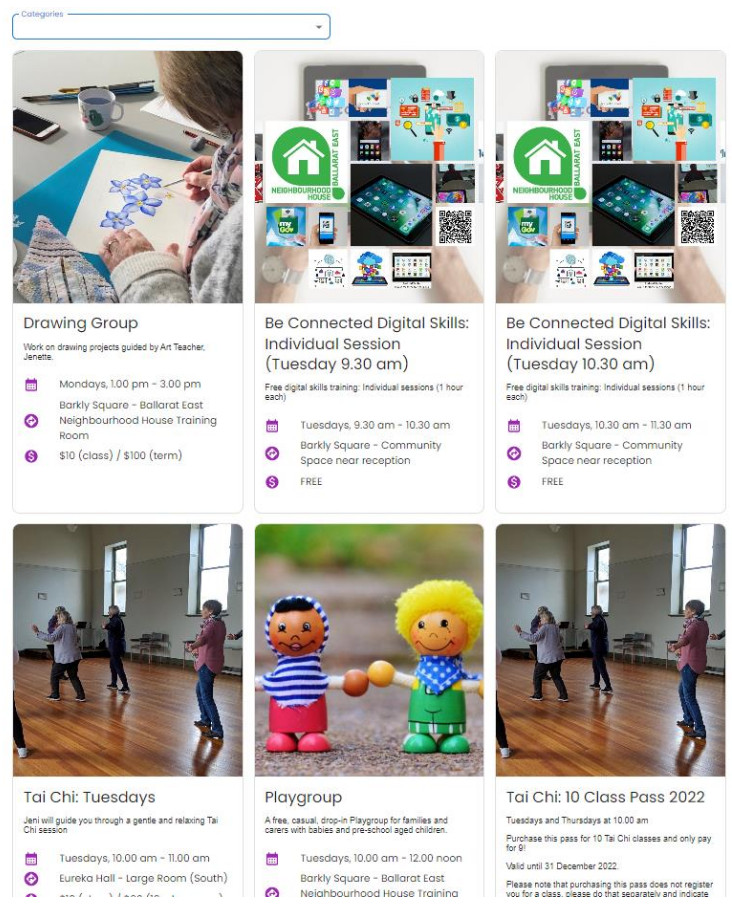
Visit the Ballarat East Neighbourhood House Online Activity Registration page:
Step 2
You can scroll through the list of activities or filter them by their Categories in the drop down box at the top left of the page. The options are (1) Adult Education, (2) Health and Wellbeing, (3) Social Connection and (4) Art and Craft: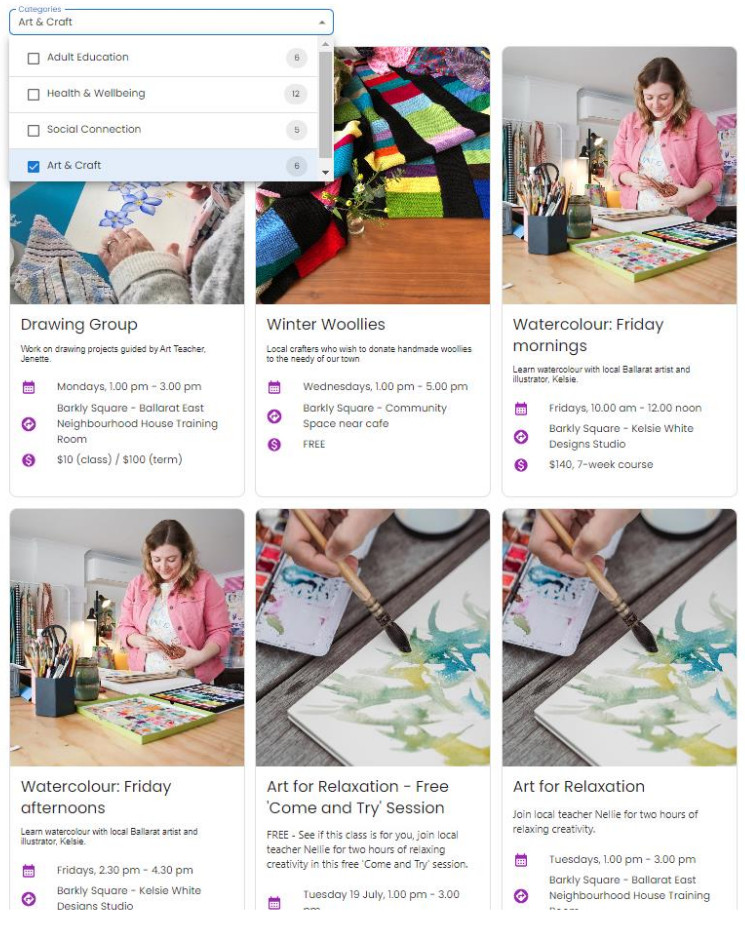
Step 3
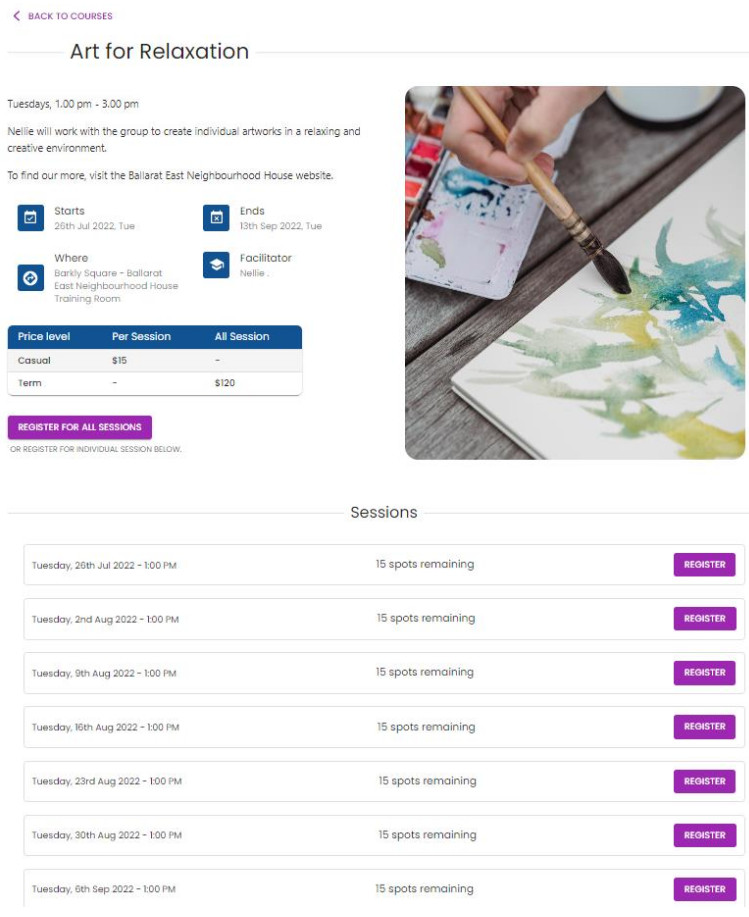
Once you have selected the activity for which you want to register, you will be able to find out a bit more about it and either (1) Register for all sessions or (2) Register for individual sessions using the purple buttons. Some activities are only available as a course, in which case you will need to register for all sessions and the individual session buttons will not be available:
Step 4
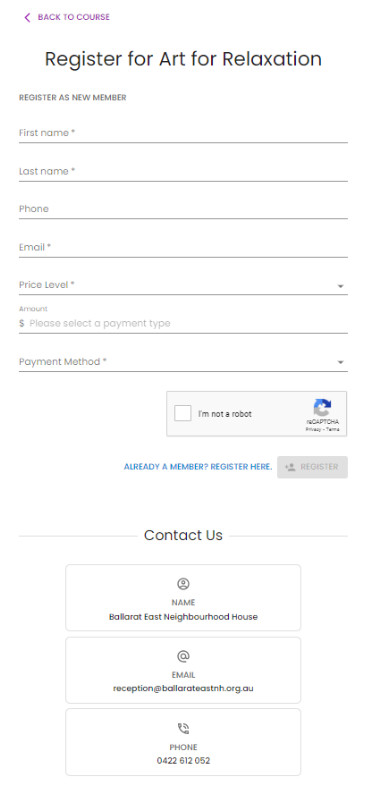
If you have not participated in an activity with the Ballarat East Neighbourhood House in the past 2 years or you think we may not have your email address, then please 'REGISTER AS A NEW MEMBER' by completing this form. Please note that this does not indicate that you are registering as a Member of the Ballarat East Neighbourhood House, rather an active participant of the House. If you are interested in becoming a Member of the Ballarat East Neighbourhood House, please contact us.
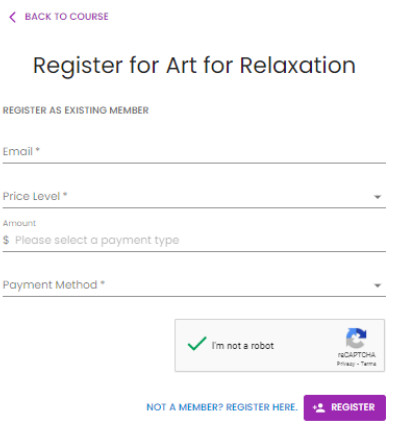
However, if you think we may already have your email address in our online system because you have participated in an activity with the Ballarat East Neighbourhood House in the past 2 years, please scroll to the bottom of this form and select 'ALREADY A MEMBER? REGISTER HERE'. This indicates that you are an active participant of the House.
Step 5
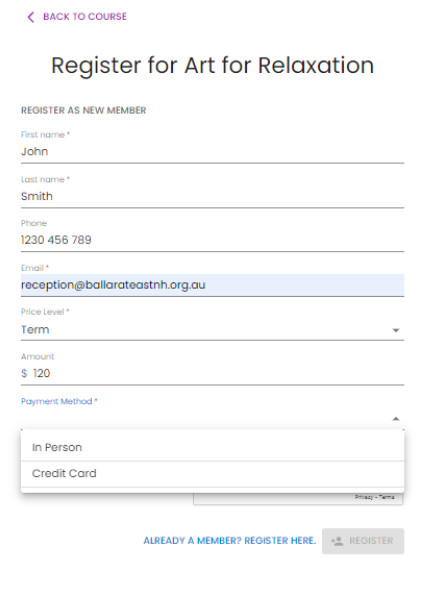
Complete the form with your contact details. If you don't have an email address, you will need to contact us to complete the registration for you.
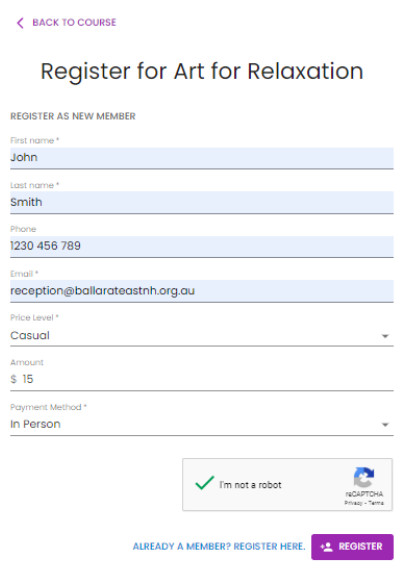
When you select the 'Price Level', the 'Amount' field will automatically be populated. If you selected to 'Register for all sessions' on the previous screen, then the full term/course price will come up. If you selected 'Register for individual session' on the previous screen, then that individual session price will come up. You can only register for one individual session at a time.
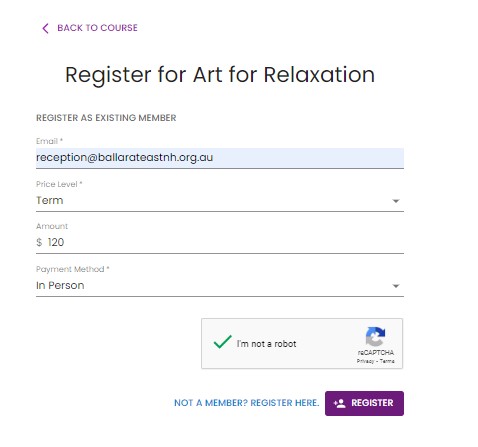
The 'Payment Method' options are: (1) Credit Card and (2) In Person. If you select to pay In Person, please bring the correct cash to your first session.
Step 6 - Already a Member?
If you click the purple 'Register' button and get the red error message "Email already in use. Register as existing member instead" then your email address is already in our online system from a previous time you have been invovled with the Ballarat East Neighbourhood House.
In this case, please scroll down and click on the blue writing "ALREADY A MEMBER? REGISTER HERE." 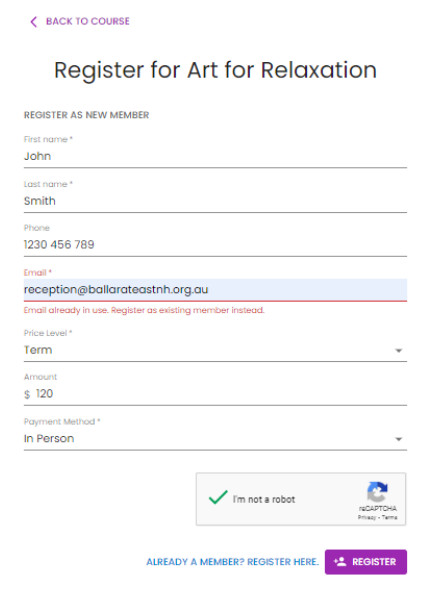
Step 7 - Register as Existing Member
If we have your email address already registered in the Ballarat East Neighbourhood House online system, you can select the option to 'Register as Existing Member'. Please note (as above) that this does not indicate membership of the Ballarat East Neighbourhood House, rather that you are a participant of House activities.
Step 8 - Pay In Person
If you would like to secure your place in an activity for a whole term and pay cash in the first session, please complete the form as seem below.
Step 9 - Pay Online
If you would like to pay online, please note that there is a small surcharge. 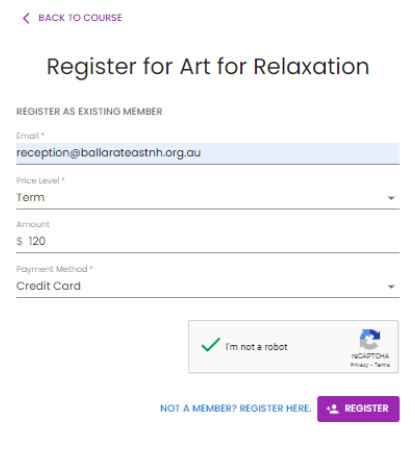
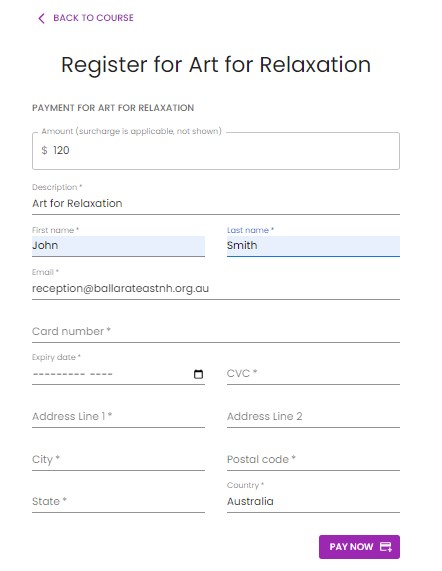
Step 10 - Register for individual sessions
There is also the option to register and pay for individual sessions. Please note that this option is not available for all activities.
To secure your place in a term activity, we recommend paying upfront for the whole term if this is possible for you. If this is not an option for you, please contact us to discuss payment options.
Step 11 - Registration Confirmation
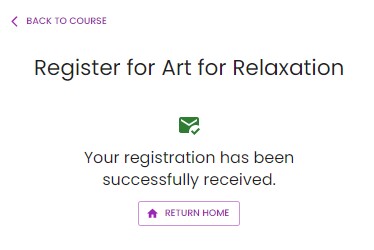
When you click on the purple 'Register' button, you will receive a message on the screen 'Your registration has been successfully received'.
Please note, that automatic email confirmations are still under development and will be available shortly. At this stage, you will not receive an automatic email confirmation from the online system. Until that function is available, our team will be maually contacting people who have registered. Please note that this may take a day or two, particularly at the start of term when registrations first open.
Thank you for registering for an activity with the Ballarat East Neighbourhood House! We look forward to seeing you soon. If you have any questions, please contact us.
Activity Terms and Conditions
Ballarat East Neighbourhood House - Terms and Conditions for Participants
Last updated 29 April 2022
Neighbourhood Houses welcome people from all walks of life.
Ballarat East Neighbourhood House enriches our local community through advancing social and public welfare by advancing mental health and preventing social isolation and providing a physical location where we support individuals to undertake activities, or work on projects, in the company of others.
Some activites run by the Ballarat East Neighbourhood House are "user-pays", such as Tai Chi, Drawing Group and Watercolour. This means that the money paid by each participant goes toward paying for room hire, tutor fee, supplies, catering, administration, marketing and other costs. Any profits are invested by the Ballarat East Neighbourhood House in community development activities.
To keep participant costs low, other activities are externally funded through sources such as the State Government's Adult, Community and Further Education (ACFE) and Learn Local programs. This funding can help to cover the cost of the tutor and contribute to room hire. A participation fee is often also charged to contribute to the cost of supplies, catering, administation, marketing and other costs. The Ballarat East Neighbourhood House is not an ACFE or Learn Local provider, so we partner with the Ballarat Neighbourhood Centre (BNC) and Wendouree Neighbourhood Centre (WNC) to deliver ACFE and Learn Local activities on their behalf.
Terms and Conditions
Code of Conduct
In order to provide a safe and welcoming environment for staff, participants and visitors at the Ballarat East Neighbourhood House (BENH):
- Staff, volunteers, participants and visitors will treat each other with respect and courtesy at all times
- Anti-social behaviour, including harassing staff, volunteers, participants or visitors is not permitted. This includes the use of offensive or threatening language and the making of threats;
- Behaviour or language which offends, insults, humiliates or intimidates another person or group of people on the basis of race, ethnic origin, gender, age or disability, or is disruptive in any way will not be tolerated.
COVID-Safe Principles
- All participants in Ballarat East Neighbourhood House activities must follow the current Statewide COVID-Safe principles.
- If you are feeling unwell and/or have cold/flu symptoms please do not come to the activity.
- Please sanitise your hands upon entry to and exit from the activity. Hand sanitiser will be available.
- Keep at least 1.5 metres from other people in the activity.
Photographs, Recordings, Work Product and Testimonial Consents
Ballarat East Neighbourhood House (BENH) from time to time uses photographs, recordings, work product and testimonials to promote BENH and its Third Party’s activities. We only use this information under the guidelines as set out in the Privacy Act 1998.
By ticking the YES box for photographic consent and signing the Ballarat East Neighbourhood House Registration Form you have read (or had read to you) this Personal Consent Statement and understand the consent given here.
By giving your consent you have agreed to:
- Your images, either photographs or recordings, work product and testimonials being used in any and all marketing and promotion including but not limited to print / social media, websites, promotional flyers and materials.
- Not to take legal action or seek payment or benefit against the Ballarat East Neighbourhood House for any reason relating to those uses of the material.
- You have the right to withdraw your consent at any time prior to the publication of the images, work examples or testimonials by writing to the BENH Manager with your request to withdraw consent.
- If you only wish to give consent for specific situations please contact our office for a separate consent form.
Note: Staff will also verbally ask for your consent before taking any photos or recordings, giving you the opportunity to opt out of a photograph or recording at any time.
Physical Activity
As a participant of activities including physical movement such as Tai Chi/Yoga/Walking Group/Delivering Newsletters:
- You agree that this activity is aimed at both enjoying the physical activity as well as the company of others.
- You are aware that there is a risk in any physical activity, including Tai Chi/Yoga/Walking Group/Delivering Newsletters, and you voluntarily accept that risk.
- You declare that you are physically capable to undertake this activity, and will seek medical advice before commencing if you have any concerns regarding your capacity, for example, due to any medical condition.
- You acknowledge that you are responsible for your own safety whilst participating in any Ballarat East Neighbourhood House activity, particularly those which include physical movement. You accept it is your sole responsibility for all risks and liabilities that may arise from your participation, and release the Ballarat East Neighbourhood House and its members from claims, liability, demands and proceedings from or in relation to any loss, damage or personal injury which may be sustained as a result of your participation.
- If you have any injuries or issues which may affect your ability to partipate fully in the activity, please arrive early and discuss with the activity organiser.
Fees and Enrolment
Ballarat East Neighbourhood House will keep fees to a minimum to ensure everyone has the opportunity to participate in our programs and activities.
Some activities run by Ballarat East Neighbourhood House are pay-as-you-go, cash on the day. For other activities, we ask participants to pay the activity fees either in cash, via EFTPOS or by on-line payment prior to the activity commencement date.
If you are having difficulty in paying the full fee in one payment, payment can be made by instalment. For people experiencing financial hardship, the fees may be waived with approval from the Manager.
Registrations can be made over the phone or in person, but a place in a course is not confirmed until a registration form is completed and the payment received. If a place is not available, your name will be placed on a waiting list.
For enrolment in an ACFE-funded class run in partnership with the Ballarat Neighbourhood Centre or Wendouree Neighbourhood Centre, please note you must be aged over 16 years and meet Department of Education eligibility criteria.
Class Attendance
Certificates of Participation are issued for all Learn Local funded classes for learners who have attended at least 75% of their scheduled classes.
If you are unable to make a class please contact the Ballarat East Neighbourhood House as soon as possible to let your tutor know of your non-attendance. Please leave a message if calling outside office hours.
Disclaimer
The information provided by Ballarat East Neighbourhood House on these pages is provided as a guide only. It is intended to assist you with your participation in our education, training and community activities. All information is provided in good faith and to the best of our abilities. However, we cannot guarantee there are no mistakes or errors. We reserve the right to cancel classes and make amendments and changes to this information at any given time.
Cancellation and Refund Policy
Cancellation Policy
Ballarat East Neighbourhood House (BENH) reserves the right to cancel activities if the required minimum number of participants enrolled prior to the activity starting date is not met. A full refund will be given for payments received.
Refund Policy
Fee refunds are not automatic and must be applied for in writing to the Manager.
The following will be taken into account before a Refund is issued:
- Approved fee refunds are only processed after the fees have been cleared through the bank account.
- A student excluded, suspended, or expelled under a BENH/BNC/WNC policy or procedure is not entitled to a refund (except where any Commonwealth or State legislation or code of practice provides otherwise).
- Where the student ceases training of their own volition prior to the midway point of the program (defined as midway through unit completion, or midway through time period of course, whichever is the earlier), the maximum fee refund will be 50% of the total fee payment.
- Where the student ceases training of their own volition after the midway point of the program as defined above, no refund is payable.
- Refunds will not be issued after course commencement except in exceptional circumstances or where funding guidelines stipulate this requirement. In exceptional circumstances a participant may apply in writing for special consideration of a refund for the following bereavement, hospitalisation and/or unexpectedly having to assume carer’s responsibilities.
- BENH will not issue refunds for a change in working hours; inconvenient travel; moving interstate; job change or change of career direction or change of mind.
- Actual attendance in class by the student will not be considered when assessing a refund request.
Privacy Policy
Ballarat East Neighbourhood House Privacy Declaration
Ballarat East Neighbourhood House (BENH) respects and upholds your right to privacy in the way we collect, store and use the information you provide to us. Information we collect from you is held in accordance with information privacy laws and the BENH Privacy Policy.
The BENH Privacy Policy requires staff and Committee members to be consistent and careful in the way they manage what is written and said about individuals and how they decide who can see or hear this information. The BENH Privacy Policy can be viewed on the BENH website:https://www.ballarateastnh.org.au/about-us/privacy-policy-full
Third Party Reporting
As part of our relationship with government departments, funding partners and referral agencies, we are required to collect and provide them with a range of program / project data and information.
If a third party (agency, employer or other organisation) is paying for or funding a course / activity, please be aware we may provide them with information as required and in compliance with privacy laws.
2022 Victorian Government VET Student Enrolment Privacy Notice
Why we collect your personal information
As we partner with registered Learn Local Organisations (LLO), we collect your personal information so we can process and manage your enrolment in an adult, community and further education course (ACFE) with us.
How we use your personal information
We use your personal information to enable us to deliver ACFE courses to you, and otherwise, as needed, to comply with our partners' obligations as LLOs.
How we disclose your personal information
We are required by law (under the National Vocational Education and Training Regulator Act 2011 (Cth) (NVETR Act)) to disclose the personal information we collect about you to the National VET Data Collection kept by the National Centre for Vocational Education Research Ltd (NCVER). The NCVER is responsible for collecting, managing, analysing and communicating research and statistics about the Australian VET sector, which includes the ACFE sector.
We are also authorised by law (under the NVETR Act) to disclose your personal information to the relevant state or territory training authority.
How the NCVER and other bodies handle your personal information
The Victorian Government, through the Department of Education and Training (the Department), develops, monitors and funds vocational education and training (VET) in Victoria. The Victorian Government is committed to ensuring that Victorians have access to appropriate and relevant VET services. Any personal information collected by the Department for VET purposes is protected in accordance with the Privacy and Data Protection Act 2014 (Vic) and the Health Records Act 2001 (Vic).
Collection of your data by Ballarat East Neighbourhood House and sharing with our relevant ACFE/LLO providers
Ballarat Neighbourhood Centre (BNC) and/or Wendouree Neighbourhood Centre (WNC) is required to provide the Department with student and training activity data. This includes personal information collected in the enrolment form and unique identifiers such as the Victorian Student Number (VSN) and the Commonwealth’s Unique Student Identifier (USI). BNC and WNC provide data to the Department in accordance with the Victorian VET Student Statistical Collection Guidelines, available at DET website: https://www.education.vic.gov.au/training/providers/rto/Pages/datacollection.aspx
Use of your data
The Department uses student and training data, including personal information, for a range of VET purposes including administration, monitoring and planning, including interaction between the Department and Student where appropriate. The data may also be subjected to data analytics, which seek to determine the likelihood of certain events occurring (such as program or subject completion), which may be relevant to the services provided to the student.
Disclosure of your data
As necessary and where lawful, the Department may disclose VET data, including personal information, to its contractors, other government agencies, professional bodies and/or other organisations for VET-related purposes. In particular, this includes disclosure of VET student and training data to the Commonwealth and the National Centre for Vocational Education Research (NCVER).
Legal and Regulatory
The Department’s collection and handling of enrolment data and VSNs is authorised under the Education and Training Reform Act 2006 (Vic). The Department is also authorised to collect and handle USIs in accordance with the Student Identifiers Act 2014 (Cth) and the Student Identifiers Regulation 2014 (Cth).
Survey participation
You may be contacted to participate in a survey conducted by NCVER or a Department-endorsed project, audit or review relating to your training. This provides valuable feedback on the delivery of VET programs in Victoria. Please note you may opt out of the NCVER survey at the time of being contacted.
Consequences of not providing your information
Failure to provide your personal information may mean that it is not possible for you to enrol in VET and/or to obtain a Victorian Government VET subsidy.
Access, correction and complaints
You have the right to seek access to or correction of your own personal information. You may also complain if you believe your privacy has been breached.
Further information
For further information about the way the Department collects and handles personal information, including access, correction and complaints, go to the Victorian State Government Education and Training website.
For further information about Unique Student Identifiers, including access, correction and complaints, go to the Australian Government USI website.
At any time, you may contact Ballarat East Neighbourhood House to:
- request access to your personal information
- correct your personal information
- make a complaint about how your personal information has been handled
- ask a question about this Privacy Notice
If you wish to enquire about the use of your personal information, contact us at: This email address is being protected from spambots. You need JavaScript enabled to view it.
Or
Manager
Ballarat East Neighbourhood House
PO Box 1443, Ballarat East 3354
0422 612 052
Crisis Support
The Ballarat East Neighbourhood House is a support and referral service, not a crisis service. We are able to support community members by providing information about local crisis services and contact details.
If life is in danger call 000
For mental health supports, see out Mental Health & Wellbeing Support Links page.
Lifeline
Lifeline is a national charity providing all Australians experiencing emotional distress with access to 24 hour crisis support and suicide prevention services. They exist so that no person in Australia has to face their darkest moments alone. Lifeline's 13 11 14 crisis support service is available 24/7. Anyone in Australia can speak to a trained Crisis Supporter over the phone, any time of the day or night.
Family Violence Support
For a comprehensive list of services, visit the Family Violence Support page on the Department of Families, Fairness and Housing website.
1800 RESPECT (1800 737 732) – the national sexual assault, domestic and family violence counselling service. It doesn’t matter where you live, they will take your call and, if need be, refer you to a service closer to home.
The Orange Door
The Orange Door is a free service for adults, children and young people who are experiencing or have experienced family violence and families who need extra support with the care of children.
The Orange Door in Central Highlands
1800 219 819
This email address is being protected from spambots. You need JavaScript enabled to view it.
21 Armstrong Street North, Ballarat, 3350
52 Grant Street, Bacchus Marsh, 3340
Opening hours 9.00 am to 5.00 pm Monday to Friday (except public holidays)
Services offered:
- Women, children and young people's family violence services
- Child and family services
- Aboriginal services
- Men's family violence services
WRISC
WRISC Family Violence Support Inc. welcomes all women who have experienced or are experiencing violence or abuse, and are in need of assistance, to contact us.
5333 3666
This email address is being protected from spambots. You need JavaScript enabled to view it.
205 Dana Street, Ballarat 3350
Monday - Friday, 9.00 am - 5.00 pm
Statewide, after-hours services
Safe Steps
1800 015 188
(24 hours a day, 7 days a week)
for women and children who are victims of family violence
web chat support service Monday to Friday 9.00 am - midnight
Victims of Crime Helpline
1800 819 817 or text 0427 767 891
(8.00 am - 11.00 pm, 7 days a week)
for adult male victims of family violence and victims of violent crime
Child Protection
13 12 78
(5.00 pm - 9.00 am Monday to Friday, 24 hours on weekends and public holidays)
for children and young people whose safety is at risk
During business hours, ring the number covering the local government area (LGA) where the child lives. West Division Intake - Rural and regional only - 1800 075 599
After hours Child Protection Emergency Service - 13 12 78
(5.00pm to 9.00am Monday - Friday, 24 hours on weekends and public holidays). A state-wide after hours emergency service that receives new reports, as well as concerns for existing child protection clients who are considered to be at immediate risk and require urgent after hours service.
Sexual Assault Crisis Line
1800 806 292
(24 hours a day, 7 days a week)
for victims of sexual assault
Men’s Referral Service
1300 766 491
(8.00 am to 9.00 pm Monday to Friday; 9.00 am to 5.00 pm Saturday and Sunday)
for people at risk of using family violence
free, confidential, expert support for men and their family and friends
Kids Helpline
1800 55 1800
(24 hours a day, 7 days a week)
a free, private and confidential, telephone and online counselling service for young people aged between 5 and 25
With Respect
1800 542 847
(5.00 pm to 11.00 pm each Wednesday and 10.00 am to 10.00 pm on Saturday and Sunday)
specialist LGBTIQ family violence service
MensLine Australia
1300 78 99 78
(24 hours a day, 7 days a week)
is a telephone and online counselling service for men with family and relationship concerns
COVID-19
Visit the Department of Health and Human Services website.
Ballarat and Grampians Community Legal Service
Ballarat & Grampians Community Legal Service (BGCLS) is a not-for-profit organisation providing free legal advice, information and community legal education to people who live, work or study in the Central Highlands and Wimmera regions of Victoria.
5331 5999
1800 466 488 (freecall)
This email address is being protected from spambots. You need JavaScript enabled to view it.
Victoria Legal Aid
Victoria Legal Aid helps people with their legal problems. They focus on protecting the rights of Victorians and representing those who need it the most.
1300 792 387, Monday to Friday from 8.00 am to 6.00 pm.
Mental Health & Wellbeing Support
In an emergency: call 000
If you require access to Crisis Support, please see our Crisis Support contacts page.
If you are feeling anxious, lonely, isolated or in need of support, we recommend contacting or chatting online with the following organisations:
Lifeline: 13 11 14
Beyond Blue: 1300 224 636
Kids Helpline: 1800 55 1800
Headspace: 1800 650 890
Grampians Area Mental Health Service: 1300 247 647 (24 hours)
HeadtoHelp: 1800 595 212
CAFS: 1800 692 237
Ballarat Mental Health Support: Helping you find mental health and suicide prevention services in the Ballarat region.
Ballarat Quicklist of Help for Health and Wellbeing - Ballarat Wellbeing and Health.pdf (ballaratnc.org.au)
Ballarat Quicklist of Help for Health and Wellbeing Senior Services - Ballarat Senior Well being info.pdf (ballaratnc.org.au)
Black Dog Institute Black Dog Institute | Better Mental Health | Science. Compassion. Action.
Relationships Australia Mental Health | Relationships Australia Victoria (relationshipsvictoria.org.au)
For Health and Wellbeing inrofmation translated into languages other than English, visit the Health Translations website.
The Ballarat East Neighbourhood House is a support and referral service, not a crisis service. We are able to support community members by providing information about local crisis services and contact details.
We are open Tuesdays to Fridays from 9.00 am - 5.00 pm during school term. You can call us on 0422 612 052 during these hours. If we are not able to answer your call, please leave a message and we will call you back.
If you need to access a Neighbourhood House while we are closed, please contact one of the other three Ballarat Neighbourhood Houses:
- Ballarat Neighbourhood Centre in Sebastopol (5329 3273, This email address is being protected from spambots. You need JavaScript enabled to view it.)
- Ballarat North Neighbourhood House in Soldier's Hill: (0491 753 307, This email address is being protected from spambots. You need JavaScript enabled to view it.)
- Wendouree Neighbourhood Centre (5303 0507, This email address is being protected from spambots. You need JavaScript enabled to view it.).
For COVID-19 updates and information, please visit the Victorian Department of Health and Human Services website.
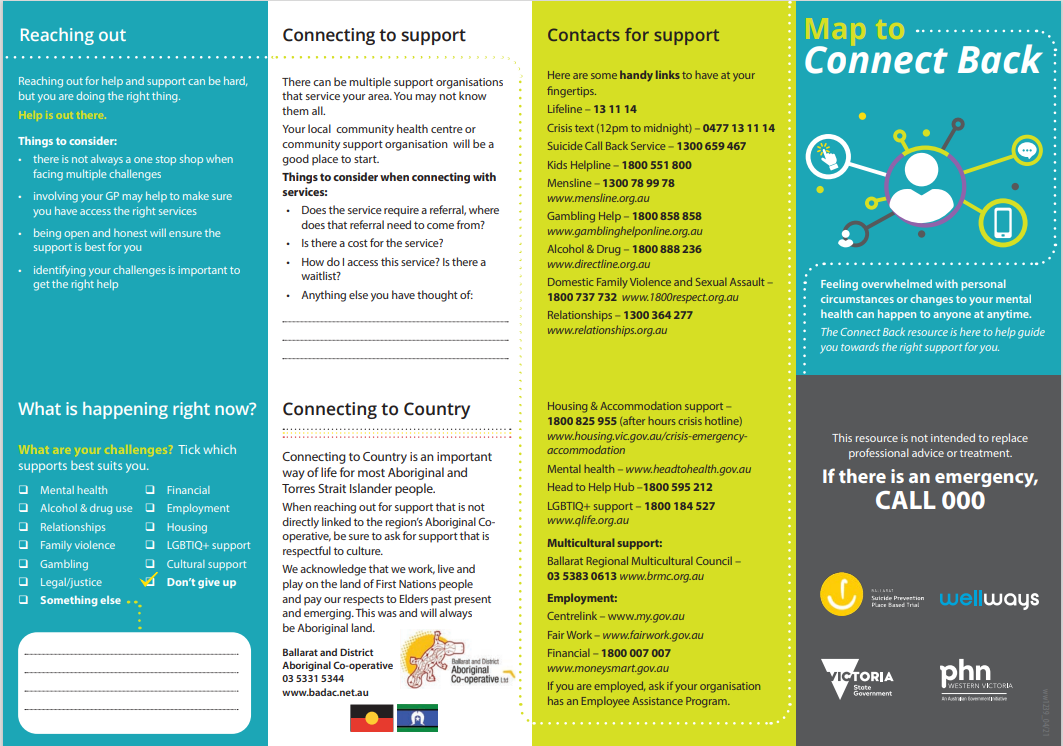
We thank the Western Victoria Primary Health Network for the following handy resource.